
The Missing Link in the Literacy Loop: REFLECTIONS AFTER SCATA

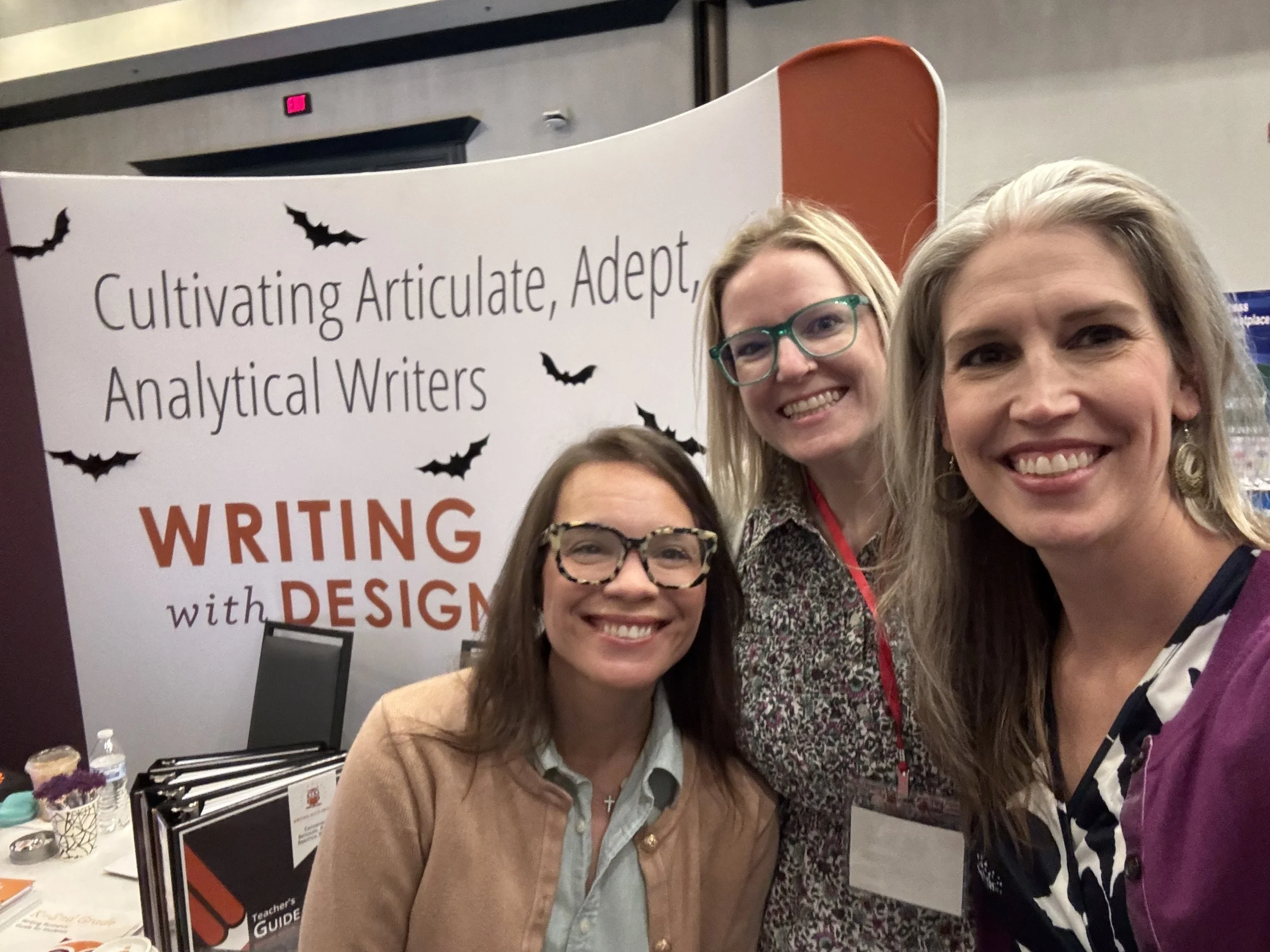
Last week, we had an incredible time at the South Carolina Association of Title I Administrators (SCATA) Conference, meeting so many building, district, and state leaders who voiced the same truth— teachers want practical, high-quality writing instruction that turns prompts on the board into purpose on the page.
As they explored our materials, heard about our professional development, and saw how we make explicit writing instruction accessible and actionable, they recognized that Writing with Design (WwD) is the missing link in the literacy loop.
WwD gives teachers and students the tools to turn prompts on the board into quality on the page—building the stamina, clarity, and confidence that writing demands.

When writing becomes the focus of literacy instruction across all subject areas, it gives reading a stronger purpose. Writing becomes the catalyst for comprehension—a way to synthesize content, clarify thinking, and deepen understanding.
As research from Graham & Perin (2007) and Sedita’s Writing Rope (2019) reminds us, writing doesn’t just demonstrate learning—it creates it. Integrating writing across disciplines transforms passive reading into active reasoning.

At Writing with Design, we have a knack for dissecting and analyzing high-scoring pieces to uncover the “how.”
How did they do that?
How can teachers teach that?
How can we empower students to do that, too?
From those questions come the practical, research-based strategies that make writing instruction more attainable—and more exciting—for every classroom. Our Skill Focus Activities and Mind Designs help teachers explicitly model craft moves, so students not only recognize strong writing but reproduce it with confidence.

For our session, Lights, Camera, Evidence, we focused on text-dependent writing (TDW) tasks—specifically, why they often feel so challenging for students. The difficulty often lies in integrating evidence and story elements in ways that feel purposeful and connected.
Educators filled the room with curiosity and energy—snapping photos of slides packed with step-by-step strategies to help students ace on-demand writing. From using direct quotations to weaving in narrative details, participants explored how identifying key words, phrases, and sentences strengthens informational and argumentative essays, and how character thoughts and descriptions help students craft captivating stories.


We also loved highlighting Knightsville Elementary in Dorchester District Two, where we’ve partnered for four years. Their SC Ready results show the power of a vertically aligned, systematic, and explicit writing framework in PreK–5th grade.
Learn more about their success story here: From Consistency to Confidence: How Knightsville Elementary Transformed Writing Achievement with Writing with Design
This partnership demonstrates how clarity, consistency, and collaboration can redefine literacy success.

We left the conference deeply encouraged by the conversations we had and the shared belief that writing is truly at the heart of literacy and learning. The enthusiasm, curiosity, and commitment of the educators we met reaffirmed why we do what we do—and why we can’t wait to continue the conversation.
Because when schools invest in explicit, systematic writing instruction, they’re not just improving test scores—they’re building thinkers, communicators, and lifelong learners.
Discover how Writing with Design helps schools deliver explicit writing instruction that connects reading, writing, and thinking in every classroom.
→ Click here to connect with us!
